What Is Slavic Folk Magic? A Village Witch's Guide to Polish Spells
By Haggath ·
Slavic folk magic is the everyday household magic of Polish and other Slavic villages — charms spoken over water, herbs blessed and hung in the rafters, salt at the threshold, red thread on a wrist, bread treated as holy. It is not a church and not a book of grand ceremonies; it is small, practical work woven into the farming year and the life of the home. A spell in this tradition is a spiritual practice and an act of care, not a guarantee of any result.
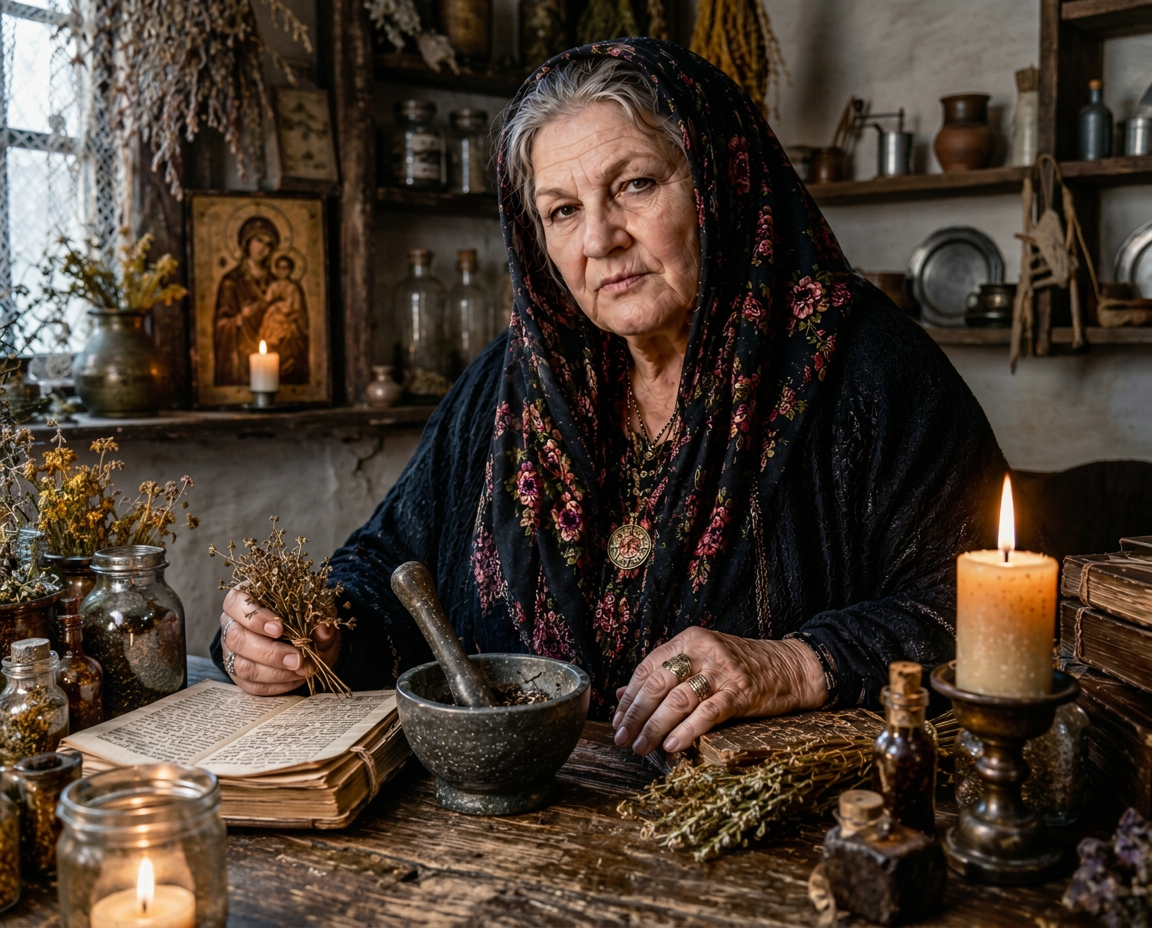
Dzień dobry, moja droga. People write to me from far away and ask, a little shyly, what exactly it is that I do. So let me sit you down by the stove and tell you, as plainly as my grandmother told me.
Where Slavic folk magic comes from
Before Poland was Christian, the Slavic peoples who lived along the Vistula and in the forests of the east honoured the sun, the waters, the household spirits and the dead. When the new faith came, the old habits did not vanish. They folded themselves quietly into the church calendar, so that a midsummer fire became St John's Eve and an autumn feast for the dead sat beside All Souls' Day. Village life kept both, side by side, for centuries.
What survived was not a priesthood or a written scripture. It was a way of doing things — how to bless a doorway, how to carry a newborn past the neighbours, which herbs to gather on which day. Ethnographers in the nineteenth and twentieth centuries wrote much of it down, and in villages like mine it was simply passed from grandmother to granddaughter, the way I learned it.
So when you hear 'Slavic folk magic', think less of wands and robes and more of a kitchen: bunches of herbs, a jar of salt, a loaf under a cloth, a candle on the windowsill.
The tools of a village witch
My tools are humble, and that is the point. Salt cleans and guards. Bread — chleb — is respected above almost everything; in Polish homes a dropped piece was once picked up and kissed. Red thread or ribbon has long been tied on children and on prams against urok, the evil eye. Beeswax, from the candles blessed at Candlemas, carries light and prayer. Water, especially water drawn quietly before dawn, carries words.
Then there are the herbs: mugwort (bylica), rue (ruta), St John's wort (dziurawiec), lovage (lubczyk), wormwood, dill and many more. On the Feast of the Assumption, 15 August — which Poles still call Matka Boska Zielna, Our Lady of the Herbs — people carry bouquets of herbs and grain to church to be blessed, then dry them at home for the year ahead.
None of these things is magic on its own, moja droga. They become part of a spell through intention, words and the care with which they are used.
Spoken charms and whispering
Much of the old magic was spoken. In Polish the word zamawianie means, roughly, 'speaking over' something — a wound, a fright, a sick animal. In eastern Poland, around Podlasie, there are still women called szeptuchy, 'whisperers', who murmur prayers and charms over the people who come to them. Their tradition is a living one, and I do not claim to be one of them; my own village is in the south, near Kraków.
What I keep from that wider tradition is the respect for words. When I cast, I speak plainly and aloud. I name the person I am working for, I name the trouble, and I name what I am asking for. Words are not decoration in folk magic; they are the work itself.
The ritual year: when the old customs happen
Folk magic follows the year. In spring, at the end of winter, villages carried out a straw figure of Marzanna and drowned or burned her, sending winter away. At midsummer comes Noc Kupały, Kupała Night, with fires, herb gathering and girls floating wreaths on the river. Late summer brings the blessing of herbs and the harvest festival, dożynki, with its wreath woven from the last grain.
Autumn is the time of the dead: Dziady in the old reckoning, and today the candles of All Saints' and All Souls' Days on 1 and 2 November. Christmas Eve, Wigilia, is thick with small customs — hay under the tablecloth, an empty place set for the unexpected guest, a carp scale tucked in the wallet for the year's money. At Epiphany, chalk letters are written over the door.
I time much of my own work by this calendar and by the moon, because the old people did. I write more about timing in my journal post on moon phases and Kupała Night.
What a spell is, and what it is not
A spell, in my tradition, is a focused act of prayer and intention, carried out with physical things: a candle burned down, a thread knotted, salt laid on a sill, words spoken over water. It is a way of asking for help and of turning your own heart and attention towards what you hope for.
It is not a machine. I cannot promise that a person will return, that money will arrive or that a trouble will lift on a certain date, and nobody honest can. Results vary from person to person, and many things in life are outside any witch's hands. A spell is also never a replacement for a doctor, a lawyer or a financial adviser. If you are unwell, in danger or in serious debt, please get that help too.
How I bring these customs into my spells
When you order from me, I read what you have written, choose the materials that suit your trouble — red thread and lovage for love, salt and rue for protection, bread, wheat and coins for money — and cast the spell by hand at my table. Afterwards I write you a letter, delivered as a PDF to your account and email, telling you what I did and what small things you might keep in your home.
If you would like to begin gently, look at my spirit and energy spells, or the ancestor blessing spell, which draws on the old respect for the family dead. If something more particular is troubling you, the custom spell lets you tell me in your own words.
Spells mentioned in this article
Questions people ask
Is Slavic folk magic the same as Wicca?
No. Wicca is a modern religion founded in England in the twentieth century. Slavic folk magic is a much older, loose body of village customs from Poland and other Slavic lands, with no founder and no fixed ceremonies.
Is Polish folk magic Christian or pagan?
Both, in a way. Many customs began before Christianity and were later folded into the church calendar, so you find midsummer fires beside St John's Day and herb blessings on a Marian feast.
Do I need to be Polish or Slavic to receive a spell?
No. I cast for people anywhere in the world. You only need to tell me honestly what is troubling you.
Can a spell guarantee a result?
No. A spell is a spiritual practice, and results vary. Anyone who promises you a guaranteed outcome is not being honest with you.
What will I receive after ordering?
I cast the spell by hand and send you a letter as a PDF in your account and by email, describing the work. Nothing physical is posted.
Would you like me to cast for you?
If you would like me to cast for you in the old way, start with my spirit and energy spells — or write to me through a custom spell.
See spirit & energy spellsResults vary. A spell is a spiritual practice, not a guarantee, and never a substitute for medical, legal or financial advice.
More from the journal
- How to Prepare Before Ordering a Spell, and What to Do Afterwards
A practical guide to preparing before you order a spell from Haggath, what to write, what happens during casting, and sensible things to do afterwards.
- Ancestor Veneration in Polish Tradition (Dziady) and Ancestor Blessing Spells
Dziady, the Slavic feast of the dead, its customs, how it lives on in All Saints' and All Souls' Days in Poland, and how ancestor blessing spells honour the family.
- How to Choose a Genuine Spell Caster: Red Flags and Scams to Avoid
An honest guide to choosing a spell caster: the red flags of spell scams, what a genuine caster does, and the questions to ask before you pay anyone.